Kate Kim

Last weekend, IndyCar arrived in Markham for the first Ontario Honda Dealers Indy at Markham. The cars raced on a new street circuit. As that was happening, we were tuned in another race too. Just the one happening in the feed.
Motorsport produces more data than almost any sport. Lap times. Positions. Pit windows. Championship points. Yet some of the strongest social content in racing is not winning because it has a better stat graphic. It is winning because it gives fans a person, a moment or a story they want to be part of.
That makes motorsport one of the clearest proof points for a broader shift we see across social: specificity beats polish, and real stories often beat stat wars.
If story-first content can win in motorsport, it can win almost any industry.
Racing is built around measurable performance. Brands have an endless supply of results, rankings and technical detail to post. That makes it tempting to treat the feed like a scoreboard.
But fans do not follow teams only for the result. They follow drivers, rivalries, behind-the-scenes decisions, setbacks, celebrations and the moments they cannot get from the timing screen.
That is the distinction strong sports marketing strategy needs to make: the statistic can validate the story, but it rarely replaces it.
Ferrari entered the 2025 Formula 1 season as the sport’s fastest-growing team on social media after Lewis Hamilton’s move. The team added more than 5.5 million followers, an 18.7% increase, while engagement rose 42%.
Hamilton’s first post as a Ferrari driver became the most-liked Formula 1-related post at the time, reaching 5.7 million likes.
The lesson is not that every brand needs aLewis Hamilton-sized announcement. It is that the strongest asset was the moment itself: a person fans already cared about, appearing in a new context they had been waiting to see.
Ferrari did not need to explain why the moment mattered because the fans already felt it.
Joe Gibbs Racing shows the same pattern at a completely different scale. Team president Dave Alpern’s @racecarbiz TikTok content gives fans access to decisions and stories they would rarely hear from a traditional team account.
Videos in the series have attracted roughly 90,000 to 200,000+ views. One of the best examples is Alpern simply explaining why the team’s shop went without signage for years.
It works because the content gives the audience access, not because it looks expensive. A real person explaining a specific detail can create more interest than a polished recap that could have come from any team.
At Zavy, we do not think one viral post tells you much on its own. The useful question is whether a repeatable pattern sits behind it.
That means looking beyond total reach and asking what type of content is consistently earning stronger engagement, shares and sentiment - and whether the same pattern holds against competitors.
For a motorsport team, that could mean tagging posts by content pillar: driver stories, race results, behind-the-scenes, sponsor content, technical explainers, fan moments or team culture. Once the content is grouped, you can compare which pillars actually perform.
Zavy’s content tagging and content-pillar analysis are designed for exactly that kind of comparison. Teams can filter posts by theme, benchmark the results against competitors, and see which content consistently resonates rather than relying on a handful of standout posts.
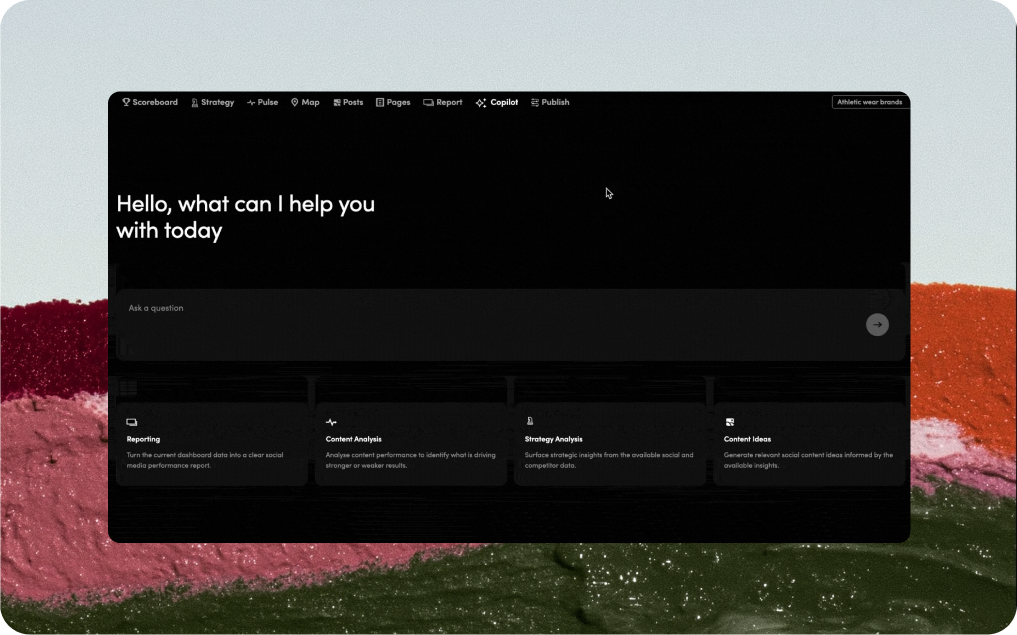
Then the analysis can move one step further. Copilot can help teams chat through the pattern, pull out the insight and generate ideas for what to create next.
The brands getting the most from social are not choosing between creativity and analytics. They use analytics to make creativity more informed.
The loop is simple:
1. Tag the content so you know what you are comparing.
2. Benchmark it against your own history and your competitors.
3. Look at engagement, shares and sentiment to understand the quality of the response.
4. Chat through the insight to understand the pattern.
5. Turn what worked into the next content idea.
That is a much stronger system than posting a result, counting the likes and moving on.
You don’t need to work in motorsport to use the same approach.
Pull up your last 20 posts and tag them by content pillar. Then ask which themes create the strongest response, which ones outperform competitors, and whether your best-performing content is built around people and moments or around announcements and statistics.
If the answer surprises you, that is useful. It gives you somewhere to go next.
Because the point of social media analytics is not to produce a prettier report but rather, make the next decision driven by the numbers of the people.
The Zavy view: Measure the pattern, not just the post. Then use the pattern to decide what to make next. Book a demo and we'll show you step-by-step how you can start understanding your numbers or try it for free.


.avif)